
Get Your Free Copy
Sign up here to get a free digital copy of the whole book.
The Kindle edition is also available now from Amazon. Physical copies ship in November (UK) and January (USA).
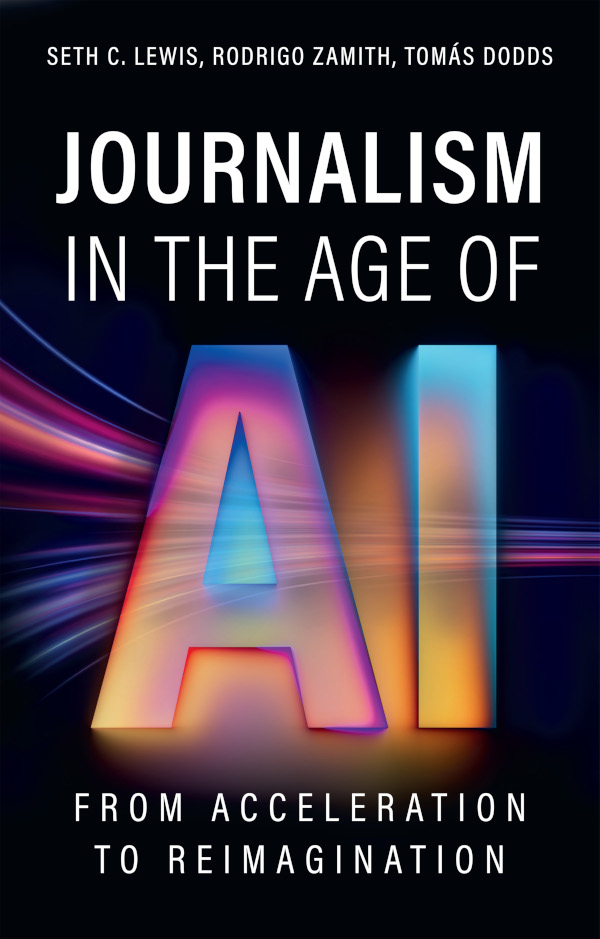
Journalism in the Age of AI
From Acceleration to Reimagination
"Journalism in the Age of AI gives readers the language to confront what has been, until now, only a felt sense among those of us working in innovation and news."
Artificial intelligence is reshaping how we create, how we learn, and how we understand the world around us. And journalism, the institution society depends on most to make sense of the world, sits at the center of this transformation.
But there's a problem: the way journalism and AI are developing together right now isn't working. It's largely accelerating a broken system that has been grinding journalists and public trust down for decades.
It doesn't have to be this way, though.
This book argues that AI can also offer a turning point for journalism — a rare chance to break the cycle and build something better. Drawing on questions of creativity, democratic accountability, platform power, and human agency, it offers a toolkit for reimagining journalism in the age of AI — not just as an industry, but as a profession dedicated to serving the public good.
This book is essential reading for anyone who cares about the future of news and democracy.
Book Contents
Chapter 1: Journalism's Constitutive Moment
AI is forcing journalism to rethink what it is and how it works. For years, digital demands pushed journalists into a “hamster wheel” where they were asked to produce more with less. AI now challenges the assumption that humans must do the work. We trace three waves of newsroom automation, each marked by hype and messy adoption, culminating in generative AI's present reach into creative and cognitive tasks. But AI is not just technology. It is shaped by culture, institutions, and choices — meaning journalism can still shape its AI future.
Chapter 2: The Newsroom Accelerates
AI is already reshaping every stage of news production, from story ideation to distribution. Right now, most uses automate routine tasks and boost efficiency. That fits journalism's habit of absorbing new tools without changing much. But the common "replacement" framing misses the point. We argue for focusing on complementarity: what journalism does AI make newly possible, not just faster? This chapter examines some emerging applications that show real transformative potential. But whether AI reinvigorates or just further accelerates journalism's hamster wheel depends on intentional choices by newsrooms and institutions.
Chapter 3: The New Architecture of Media Power
Media power used to be about who owned newspapers and TV stations. Now, it is more about who controls the technology, cloud infrastructure, and distribution systems that journalism runs on. This chapter examines how a handful of major AI and tech companies have become journalism's landlords — and how the prospects of AI-powered answer engines and vanishing search traffic are severing the economic lifeline between publishers and audiences. What's at stake isn't just ad revenue; it's whether journalism can maintain editorial independence and financial sustainability when the operational infrastructure increasingly belongs to someone else.
Chapter 4: Designing AI for Democracy
AI is reshaping how people understand the world, develop their opinions, and participate in public life — and the dominant logics driving its development, from Silicon Valley's voracious capitalism to Beijing's authoritarian control, appear more likely to corrode democratic life than strengthen it. This chapter examines AI's impact across three dimensions essential to democracy: public understanding, deliberation, and participation. The trajectory isn't inevitable, but redirecting it requires deliberately building AI systems that serve democratic goals — a challenge journalists can help address but that extends well beyond journalism alone.
Chapter 5: Learning to Think in the Age of AI
Journalism education is a revealing test case for AI's impact on learning. Students must develop judgment: identifying news, evaluating sources, building narratives. But AI can now approximate these capacities. This chapter argues that framing AI in education primarily as a cheating problem, as many universities have, fundamentally misses the point. The deeper question is whether education can empower students to work thoughtfully with AI rather than be diminished by it — and ensure they're not just feeling knowledgeable but actually becoming knowledgeable. This requires reimagining how we teach, not just writing new policies.
Chapter 6: Reimagining Journalism for the Age of AI
The trajectory we are on with AI seems to be leading somewhere bleak: deprofessionalization erodes what makes journalism distinct, infrastructural capture hands control to tech giants, democratic corrosion weakens the public sphere, and cognitive atrophy diminishes the human judgment that AI can't supply. But the constitutive moment is still open. This chapter makes a case for what a reimagined journalism in the age of AI might look like and offers some orientation toward that end. The hamster wheel is not destiny, and decisions being made right now — by journalists, news organizations, educators, policymakers, and citizens alike — will shape what happens next.
Praise
“This book provides a much-needed, calm, conceptual analysis of Al in contemporary journalism that cuts through the dystopian and utopian hype. It makes a compelling case that journalism is facing a fundamental challenge and needs to respond with public interest at the heart of its future.
“Journalism in the Age of AI provides a clear-eyed and careful assessment of AI's significance as a disrupter of news. Lewis, Zamith and Dodds don't sugarcoat the challenges ahead, but they provide far more than just anxious criticism and they gently invite journalists to imagine what journalism might become.
“Journalists' stories play a key role in society, when they are told by humans to other humans. AI risks disrupting that, not because AI is necessarily bad, but because AI adoption driven only by economic values risks undermining the social meaning of journalism as a practice. This sharp, well-focussed book highlights those dangers, but also the future promise, if media workers – journalists themselves – are empowered to take control of how AI is used and how it isn't.
“This book sets the stage perfectly: AI is a choice point. Lewis, Zamith and Dodds make a compelling case that the hamster wheel isn't the path. Using AI to elevate journalism is. The concrete examples make it one I'll keep recommending.
“A masterful synthesis of what really matters in journalism and AI that cuts through the hype with a grounded vision forward.
“Journalism in the Age of AI arrives at exactly the right moment and it does something that's very much needed: look beyond the newest tools and models to map the structural reordering of the information ecosystem itself. If you've been trying to make sense of where all this is heading, this book won't give you easy answers. But it will help you ask better questions, and that may be exactly what this moment demands.
“This well-researched, intellectually honest, and ultimately hopeful book deserves the attention of policymakers, educators, technologists who believe that the quality of our public knowledge determines the quality of our shared future.
“With Journalism in the Age of AI, we have a comprehensive yet highly readable account of how AI is disrupting news organizations and journalism, when they are already reeling from 25 years of digital disruption. A must read for journalists, news workers and those who teach and study in the field.
“The authors do not buy into convenient narratives of inevitable AI — instead they map the powers, politics and professional forces that shape journalism's future with AI. This book is a timely call for editors, journalists, and policymakers: the risks are real, but so are the opportunities for journalism's democratic role — if we are willing to make courageous choices.
“This book's great achievement is to show that AI is not just rewriting the news — it is reshaping how all of us come to know the world and tell truth from fabrication. Lewis, Zamith, and Dodds make a compelling case that reimagining journalism means rethinking the very infrastructure on which our shared sense of reality depends.
“An invitation to see AI not only as a tool, a threat, or as yet another instantiation of technological disruption driven by sometimes reckless and always self-interested competing corporations, but also as an opportunity to offer fresh answers to the questions of what journalism is, ought to be, and who it is for.
“Journalism in the Age of AI has arrived at the perfect moment. Written by leading scholars of journalism studies, the book expertly assembles key insights on journalistic labor, platform power, and democracy, while showing how AI is not only disrupting how we share and consume information, but also provides a rare opportunity to reimagine what good journalism could be.
“Journalism now has its Co-Intelligence handbook. Lewis, Zamith, and Dodds push back on hamster-wheel fatalism and hand working journalists, and those who teach them, a practical map to reimagine the industry. Journalism in the Age of AI gives readers the language to confront what has been, until now, only a felt sense among those of us working in innovation and news.
Coverage and Presentations
Seth, Rodrigo, and Tomás are open to media interviews, panel invitations, keynote addresses, and guest lectures. To inquire about their availability, please e-mail book@journalismandai.com.
Loading coverage and presentations…
Authors

Rodrigo Zamith